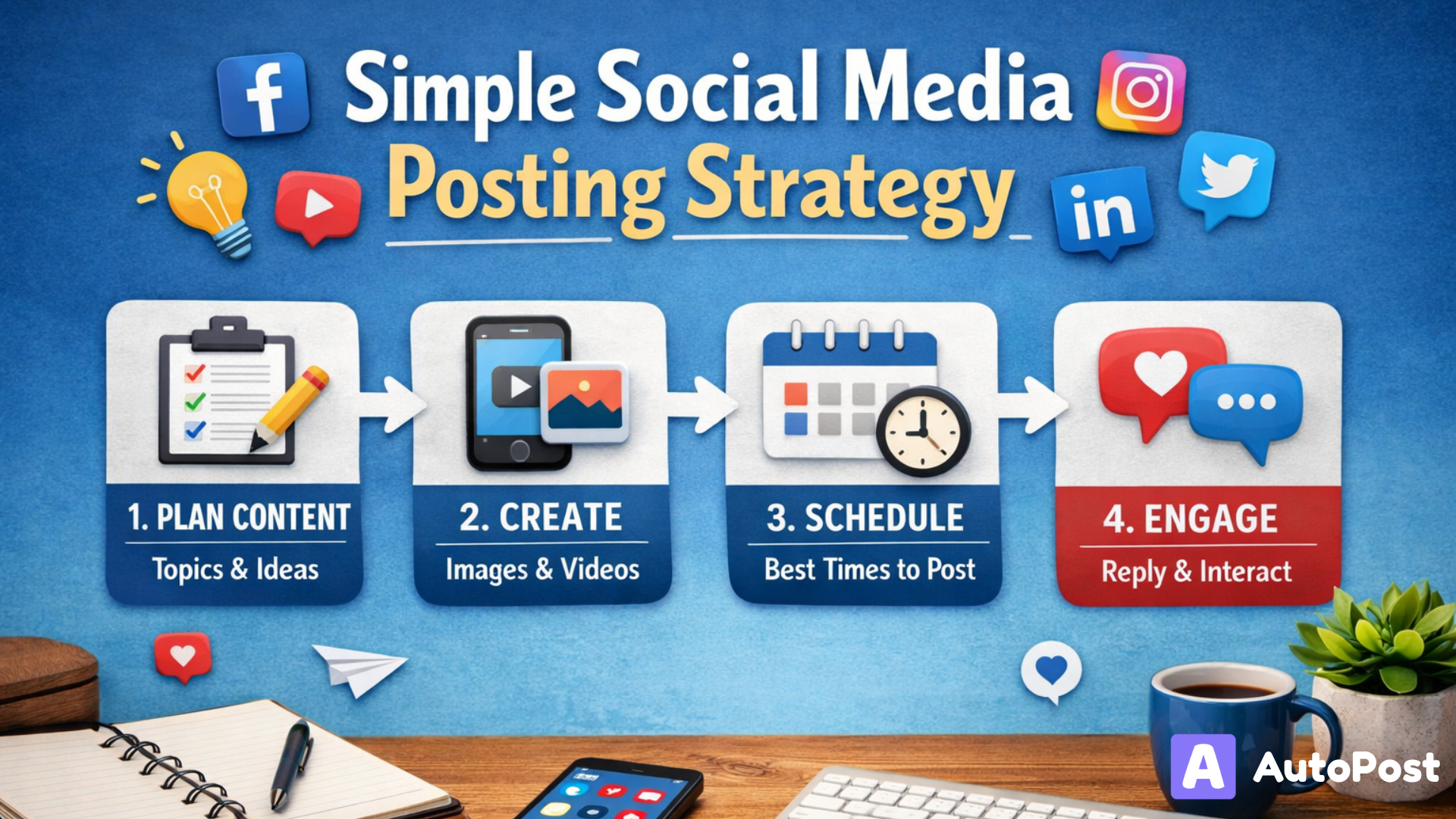
Simple Social Media Posting Strategy for Content Creators
A simple social media posting strategy focuses on clarity, consistency, and sustainability rather than complexity. Instead of trying to be everywhere, posting every day, or chasing every trend, it helps creators decide what to post, when to post, and where to post in a way that is realistic long term.
In today’s creator economy, attention is fragmented, algorithms evolve constantly, and competition increases every year. As a result, creators who rely on motivation alone often struggle to stay consistent. Those who follow a clear, repeatable posting strategy, however, are far more likely to build momentum, improve content quality, and achieve steady long term growth.
This guide breaks down a simple, modern social media posting strategy designed specifically for content creators, personal brands, solopreneurs, and small teams who want real results without burnout.

What Is a Social Media Posting Strategy?
A social media posting strategy defines how your content is planned, scheduled, published, distributed, and improved over time.
At its core, it answers practical, day to day questions such as:
Which platforms should you focus on?
How often should you post on each platform?
What types of content should you prioritize?
How do you stay consistent during busy periods?
How do you improve performance without guessing?
Unlike a full social media marketing strategy which often includes paid ads, funnels, influencer partnerships, and complex reporting a posting strategy focuses on execution.
For creators, this distinction is critical.
Growth does not come from having ideas.
Growth comes from consistently turning ideas into published posts.
A posting strategy removes uncertainty and replaces it with structure.
Why Simplicity Wins in Social Media Posting
Many creators believe social media success requires complexity. They attempt to:
Follow every trend
Use every platform feature
Post daily on multiple platforms
Copy viral creators without context
This usually leads to:
Inconsistent posting
Rushed or unfocused content
Creative exhaustion
Abandoned accounts
Frustration and burnout
A simple posting strategy works because it removes unnecessary decisions.
When creators know exactly:
what they are posting,
why they are posting it,
and how often they need to post,
They preserve mental energy for creativity instead of logistics.
Algorithms reward consistency over intensity.
A creator who posts three times per week for a year will almost always outperform someone who posts daily for one month and disappears.
Simplicity creates momentum.
Momentum compounds.
Step 1: Define Clear Goals Before You Post
Every effective social media posting strategy begins with clarity of purpose.
Before creating or scheduling content, creators should ask:
What do I want social media to do for me?
What outcome actually matters?
What does “success” look like in 6-12 months?
Common Creator Goals
Building brand awareness
Growing an engaged audience
Establishing authority in a niche
Driving traffic to content or websites
Generating leads or sales
Your goal directly influences how you post.
For example:
Awareness focused creators may prioritize reach, trends, and short form video.
Authority focused creators may post less frequently but share deeper insights.
Sales focused creators may integrate stronger calls to action and educational funnels.
Without a clear goal, creators often chase vanity metrics or copy strategies that do not align with their objectives.
A simple rule:
If a post does not serve your primary goal, it does not need to exist.
Step 2: Understand Your Audience and Each Platform
A posting strategy must account for who your audience is and where they spend time.
Different platforms reward different behaviors, formats, and posting styles. Understanding this prevents wasted effort and frustration.
Key Questions to Ask
Where does my audience already spend time?
How do users consume content on this platform?
What formats perform best here?
What type of interaction is encouraged?
Platform Behavior Overview
Instagram favors visual storytelling, carousels, short-form video, and consistency.
LinkedIn prioritizes thoughtful text posts, professional insights, and expertise.
TikTok rewards native editing, frequent posting, and audience retention.
X (Twitter) thrives on opinions, conversation, and real-time engagement.
A strong posting strategy adapts the message to the platform, instead of reposting identical content everywhere.
Creators who focus deeply on one or two platforms almost always grow faster than those trying to master all of them simultaneously.
Step 3: Choose a Sustainable Posting Frequency
Consistency matters more than volume.
A sustainable posting frequency ensures content creation fits into your life rather than overwhelming it. Many creators fail not because they post too little, but because they attempt too much too quickly.
Realistic Starting Benchmarks
Instagram: 3-5 posts per week
LinkedIn: 2-3 posts per week
TikTok: 2-4 posts per week
X: 3-7 posts per week
These numbers are not rules they are starting points.
The best frequency is the one you can maintain:
during busy weeks,
during low motivation,
and alongside real life.
Posting less often but consistently builds trust with both audiences and algorithms. Consistency signals reliability.
Step 4: Use Content Frameworks to Stay Balanced
Content frameworks prevent creators from:
overthinking,
overposting one content type,
or becoming repetitive.
One popular framework is the 70 / 20 / 10 model:
70% educational or entertaining content
20% community driven or conversational content
10% promotional content
Other creators prefer content pillars, such as:
Educational insights
Behind the scenes content
Personal stories or opinions
Promotional or announcement posts
Frameworks reduce decision fatigue.
Instead of asking “What should I post today?”, creators simply rotate through predefined categories. This keeps content varied while reinforcing a consistent brand identity.
Step 5: Plan Content in Advance
Planning is where posting strategies deliver the biggest impact.
By planning content in advance, creators:
reduce last minute stress,
improve content quality,
maintain consistent spacing between posts,
and avoid creative burnout.
Most creators plan content:
weekly (for flexibility), or
monthly (for efficiency).
Planning does not mean rigid scheduling.
It means having a clear roadmap.
A visual content calendar allows creators to:
see gaps,
maintain balance,
and repurpose content more effectively across platforms.
Step 6: Schedule and Automate Responsibly
Scheduling tools remove friction from the posting process.
Effective scheduling allows creators to:
batch content creation,
schedule posts visually,
edit or reschedule easily,
publish consistently without manual effort.
Creator focused tools like AutoPost are built specifically for this workflow supporting planning, scheduling, and consistency without overwhelming users with enterprise complexity.
Automation should support consistency, not replace authenticity.
The strongest creators use automation for logistics while staying present for engagement.
Step 7: Engage After Posting
Publishing content is not the finish line.
It is the starting point.
A complete posting strategy includes time for:
replying to comments,
responding to direct messages
participating in conversations,
acknowledging audience feedback.
Engagement builds relationships and signals value to platform algorithms. Creators who actively engage often see higher reach, stronger loyalty, and better long term retention.
Posting without engagement is broadcasting.
Posting with engagement is community building.
Step 8: Track Performance and Refine Your Strategy
A posting strategy improves through iteration, not perfection.
Creators do not need advanced analytics dashboards. Tracking a few key metrics consistently is enough:
Reach and impressions
Engagement rate
Follower growth
Clicks or conversions (if relevant)
Trends matter more than individual posts.
Over time, creators should double down on:
formats that perform well,
topics that generate engagement,
posting times that show consistency.
Reflection turns consistency into growth.
Common Social Media Posting Strategy Mistakes
Many creators struggle due to avoidable mistakes, including:
Posting without a clear goal
Trying to be active on every platform
Over promoting products or services
Ignoring analytics entirely
Expecting immediate results
Avoiding these mistakes often delivers faster improvement than increasing posting volume.
Final Conclusion: Build a Strategy You Can Sustain
A successful social media posting strategy is built on clarity, consistency, and adaptability.
Creators do not need complex enterprise systems or aggressive posting schedules to grow. They need a strategy that fits their energy, schedule, and goals supported by planning, scheduling, engagement, and regular review.
When posting decisions are clear, content creation becomes easier.
When consistency improves, growth compounds.
And when the process feels manageable, creators stay in the game long enough to see results.
The most effective social media posting strategy is not the most advanced one.
It is the one you can follow every single week.
Simplicity is not a shortcut.
For creators, it is a long term advantage.