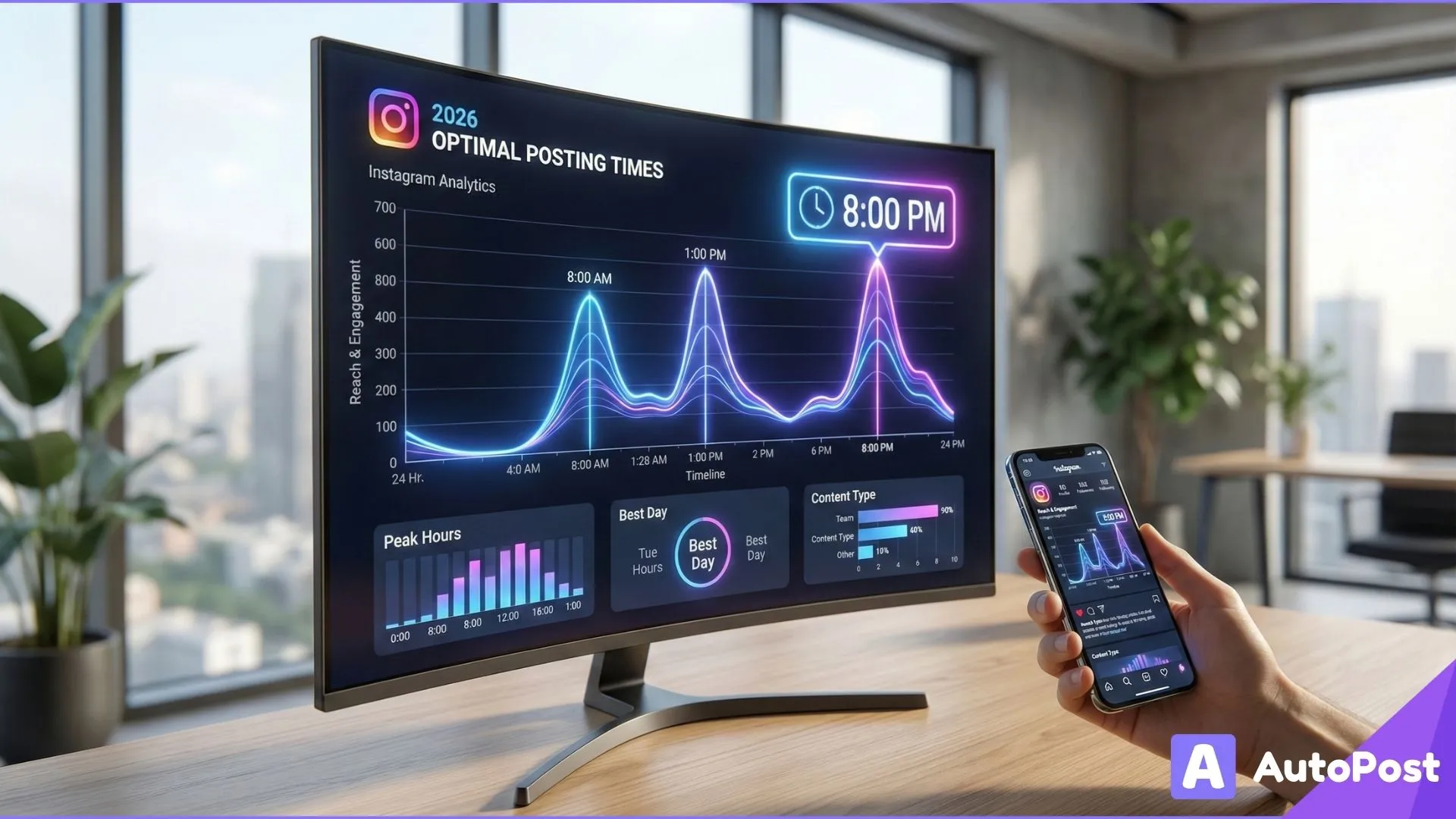
How Posting Times Affect Instagram Reach and Engagement (2026 Guide)
Knowing when to post on Instagram has become just as important as knowing what to post. Although Instagram’s feed is no longer strictly chronological, posting at strategic times can meaningfully impact how many people see your content, how quickly they interact with it, and how the algorithm pushes it to a broader audience.
This guide breaks down:
how posting times affect reach and engagement
the research behind optimal posting windows
how posting time ties into early engagement
step-by-step personalization for your audience
mistakes that reduce reach
how scheduling tools like AutoPost help creators scale
Let’s begin with the core principle:
Why Posting Time Still Matters on Instagram in 2026
Instagram’s algorithm does not display posts in strict chronological order. Instead, it sorts content based on predicted relevance prioritizing posts users are most likely to interact with based on their past behavior. But timing still matters because:
1. Early Engagement Signals
When a post goes live, Instagram evaluates how quickly and how deeply people engage. Early engagement within the first 60-90 minutes helps Instagram decide whether the content deserves broader distribution.
Posting when your followers are most active increases the chance of:
immediate likes
quick comments
saves and shares
This early engagement tells Instagram: “This content is valuable and shows it to more people.”
2. User Behavior Patterns
People scroll Instagram at predictable times:
morning routines
lunch breaks
evenings after work
weekends during free time
When you post during these active windows, your content has a higher chance of being seen while people are already scrolling. That initial visibility is vital.
3. Competition for Attention
If you post during peak posting hours but when your audience is not active, your content may initially get buried under newer posts. Posting during your audience’s active hours reduces competition and increases potential impressions.
In short: posting at the right time gives your content a head start in capturing engagement signals and those signals matter more than raw time stamps.
Instagram Activity Trends (Data Backed Overview)
The exact “best time to post” can vary by niche, audience location, and account type but there are broad patterns backed by large-scale analysis.
Best Days of the Week for Engagement
Across many industries, engagement patterns show:
Tuesday through Thursday often perform best
Wednesday frequently ranks as the most consistent high engagement day
Weekends can vary strong for B2C lifestyle niches, weaker for professional content
These patterns emerge when large datasets from millions of posts are analyzed, but your best days may vary somewhat depending on audience behavior.
Best General Time Frames
Aggregated findings suggest the following time windows (local time) tend to produce higher engagement:
Time Window | Why It Works |
9:00 AM – 11:00 AM | Morning routines, commute scrolling |
12:00 PM – 2:00 PM | Lunch breaks with free scrolling time |
5:00 PM – 8:00 PM | After work, relaxed engagement sessions |
Note: These are general trends. They give a helpful starting point but should be validated and adjusted based on your own audience’s activity.
How Posting Time Influences Different Content Types
Instagram offers multiple content formats and each interacts with timing slightly differently.
📸 Feed Posts & Carousels
Feed posts are typically higher-effort content. Users are more likely to:
read captions
save for later
leave thoughtful comments
These behaviors happen most often when users have focused attention, such as midday or early evening.
🎥 Reels
Reels can be consumed quickly and often have a longer lifespan (many hours after posting). But early reactions still matter a lot for initial distribution.
Best practice: Post Reels when your audience is actively browsing often evening and lunchtime. This helps generate early views and boosts overall reach.
📖 Stories
Stories are visible at the top of the app for 24 hours and less dependent on precise timing. Still, posting when users are likely to check Stories (morning/early evening) improves completion.
Why Timing and Engagement Work Hand in Hand
Posting time affects reach, but reach alone isn’t meaningful unless content connects with the audience. Engagement likes, comments, shares, saves amplifies reach by signaling relevance.
Here’s how timing and engagement interact:
⏱ Early Engagement Signals
When users engage soon after posting, Instagram boosts distribution. Posting when your followers are online increases the likelihood of early engagement.
📈 Engagement Momentum
High engagement early often leads to:
broadened reach beyond your followers
appearance in hashtag feeds
stronger performance on Explore and Reels tabs
🧠 Algorithm Confidence
If Instagram sees consistent engagement from your posts at a certain time, it begins to treat your content as predictable high-value, slowly increasing your reach over time.
How to Find Your Personalized Best Posting Times
General recommendations are helpful but your audience is unique. The fastest path to optimization is to use Instagram’s native insights and a structured testing approach.
🔍 Step 1: Use Instagram Insights
If you have a Professional (Creator/Business) account:
Open the Instagram app
Go to Insights
Tap Your Audience
Scroll to Most Active Times
You’ll see:
active hours
active days
This gives real data on when your followers are online. Use this as your benchmark.
📊 Step 2: Structured Timing Tests
Testing different time windows consistently over several weeks helps confirm what actually works for your specific audience.
Example test schedule (4 weeks):
Week 1: Post at 9 AM, 12 PM, 6 PM
Week 2: Post at 10 AM, 2 PM, 8 PM
Week 3: Post at 9:30 AM, 1 PM, 7 PM
Week 4: Compare results and identify patterns
Track the following for each post:
Reach
Engagement (likes, comments, saves)
Shares
Profile visits
Record your results in a simple spreadsheet or analytics tool.
🌍 Step 3: Consider Time Zones
If your audience is global, choose posting times that capture activity across regions.
Example:
If your audience is split between:
North America
Europe
Middle East
A midday posting time may align with multiple peak windows across regions.
What to Do When Your Engagement Is Low Even at “Optimal” Times
Sometimes good content still underperforms and posting time isn’t always the issue. Here are common reasons:
❌ 1. Content Isn’t Resonating
Check:
Are hooks strong?
Are captions relevant?
Is the value clear within the first few seconds?
If your audience isn’t interacting quickly, timing won’t help.
❌ 2. Hashtags Are Too Broad or Irrelevant
Hashtags help Instagram categorize posts but only if they actually match your topic. Using generic tags like #love or #instagood won’t help reach your niche audience.
❌ 3. Posting Without a CTA
Posts without a call to engagement rarely trigger meaningful actions. Asking questions, inviting saves/shares, or prompting comments encourages interaction.
Posting Frequency and Timing: A Balancing Act
There’s no universal rule for how often you should post but consistency does matter.
Here’s a common approach for creators in 2026:
Content Type | Frequency | Notes |
Feed Posts | 3-5/week | Maintain visibility without fatigue |
Reels | 1-3/week | Boost reach and discoverability |
Stories | Daily | Keep presence top-of-app |
Carousels | 1-2/week | Encourage deeper engagement |
Frequency and timing work together with consistent posts at times when your audience is active and build algorithmic trust over time.
Instagram Analytics: Using Data to Refine Your Timing Strategy
After establishing initial posting windows, analytics allow you to refine further:
✅ Metrics to Focus On
Reach over 24–72 hours (not just first hour)
Engagement rate (engagement ÷ reach)
Saves and shares (high-quality signals)
Profile visits (indicative of interest)
A post with moderate reach but high saves + shares can be more valuable than one with high reach and low interaction.
Tools That Help You Nail Posting Time Optimization
Manually tracking performance, follower activity, and posting windows is possible but tools make it faster, smarter, and predictable.
🔹 AutoPost
AutoPost helps creators:
Schedule posts in advance at peak times

Analyze engagement across posting windows
Suggest optimal time slots based on performance
Batch content for consistent posting
Track multi platform performance
Instead of posting reactively, you can plan with analytics, saving time and boosting engagement.
🔹 Other Useful Tools
Later: post scheduling with best time recommendations
Sprout Social : detailed audience activity reports
Hopper HQ: drag and drop scheduling with analytics
Metricool : performance dashboards and timing suggestions
These tools help take the guesswork out of timing and let you focus on content quality.
Common Timing Myths (Debunked)
❌ Myth: There Is One “Perfect” Time to Post
Truth: There is a best time for your audience* not a universal magic hour.
❌ Myth: Posting Overnight Always Hurts
Truth: For global audiences or niche segments (night owls, shift workers), overnight can outperform daytime.
❌ Myth: More Posts = More Engagement
Truth: Overposting can dilute engagement and algorithmic signals. Quality and timing matter more than sheer volume.
Action Plan: How to Improve Reach With Posting Time
To maximize reach and engagement:
✅ Step 1: Identify peak active hours from Insights
✅ Step 2: Establish 2-3 posting windows that match those hours
✅ Step 3: Test consistently for 4–6 weeks
✅ Step 4: Track reach + engagement + saves + shares
✅ Step 5: Refine timing and content based on results
✅ Step 6: Use scheduling tools to maintain rhythm
This systematic approach turns timing from a guess into a growth lever.
Final Thoughts
Posting times affect Instagram reach and engagement not because of the clock itself but because of human behavior and algorithmic interaction. Timely posts improve early engagement signals, which increases the likelihood of broader distribution.
Success on Instagram in 2026 comes from:
✔ Analytics driven timing
✔ High quality, relevant content
✔ Consistent posting schedules
✔ Engagement focused captions and CTAs
✔ Smart use of scheduling tools like AutoPost
When timing is aligned with audience behavior and content quality, engagement becomes less random and more predictable and that’s the real key to sustained growth.
Post with intention. Time with strategy. Engage with purpose.